The Brother Beside Him


The first time Khai wandered away at Disney World, it wasn't Pete or me who found him.
It was Silas.
We had stopped to buy something to eat, and in the span of what couldn't have been more than a minute or two, Khai slipped away the way he sometimes does. It wasn't a frantic sprint or a dramatic escape. He simply started wandering with the quiet determination that has always made him so difficult to follow. Before either Pete or I could even decide which direction to run, I heard Silas shout, "There he is!"
By the time we reached them, Khai was completely content, strolling along as though he hadn't disappeared at all. We wrapped Silas in praise, telling him how proud we were that he'd spotted his brother so quickly. His face lit up in a way I'll never forget. For the rest of our trip, I noticed him watching Khai more closely. Not because we'd asked him to, but because he wanted to.
That moment has stayed with me, not because Khai wandered away, but because it reminded me how carefully Silas has always watched his brother.
I don't remember the first time he pointed across our backyard and casually said, "Mom, Khai's down the hill." I can't tell you when it became normal for him to notice that his brother had wandered toward the back field before anyone else had. Those moments weren't dramatic enough to become memories on their own. They simply accumulated over time until I realized that Silas had quietly become fluent in his brother's patterns.
People often talk about what siblings of autistic children gain.
Empathy.
Patience.
Acceptance.
Those things are true.
Growing up beside Khai has shaped Silas in beautiful ways. We've always spoken openly about autism in our house—not just because of Khai, but because Pete experiences the world through a similar lens. We answer questions honestly. We talk about why Khai repeats movie quotes, why loud places sometimes overwhelm him, and why the same rules don't always fit every nervous system. Somewhere along the way, "Khai sees the world differently" became a sentence that belonged to all of us.
I've watched Silas explain autism to friends with a confidence that still surprises me. I've watched him encourage Khai through potty training, through regressions, and through moments when celebrating someone else's victory would have been easier to ignore. He has learned compassion in ways I never could have taught from a book.
But I think we sometimes stop the story there. We celebrate the empathy siblings develop without talking nearly enough about what that empathy costs.
There are disappointments they learn not to voice, because they know their brother is already having a harder day. There are plans that quietly change. There are moments when they instinctively wait, because someone else needs a little more time. There are afternoons when they choose understanding before anyone ever asks them to.
Children who love deeply often give quietly. That realization changed the way Pete and I parent.
Years ago, we started something we simply call Mommy and Silas Days. Sometimes they're planned weeks in advance. Sometimes I surprise him. Either way, the excitement feels almost like Christmas morning. He'll spend the entire week asking where we're going, wondering if we'll end up at Mammoth Cave, wandering through a used bookstore, or eating at Chuy's where, on one particularly joyful afternoon, he stood up in the middle of the restaurant and danced because he was simply too happy to stay in his seat. Somehow there's almost always a smoothie involved, probably because I can't seem to plan an outing without one.
Those days have never been about making up for anything. They're about making sure one remarkable little boy knows that I see him too.
The older my boys get, the more I realize that loving children equally doesn't always mean giving them the same things. Khai doesn't need Mommy and Khai Days, at least not right now. He finds restoration in different places. He finds it walking our trails, studying shadows across the pasture, drawing for hours on his dry erase board in the sunroom, or losing himself in the rhythm of something only he notices. Silas finds it in conversations over tacos, reading books on the floor of a used bookstore, hiking through caves, asking impossible questions on his bed at night, and imagining the day he'll become a park ranger.
Both of those childhoods deserve room to exist.
One of my favorite things to watch happens after dinner. We've held dance parties in our kitchen for years, long before Khai could even stand on his own. Back then, he jumped happily in his bouncer while Silas danced circles around him, completely unconcerned that his little brother couldn't yet join him. As Khai grew older, the dance parties changed too. He eventually stood beside us, then began spinning through the kitchen with the same enthusiasm as his brother. Pete and I would turn off every light in the house except a cheap laser projector we'd bought years ago. Green and red lights scattered across the floor while trip-hop music filled the kitchen, and for a little while no one was thinking about therapy appointments, school, autism, ADHD, or whether anyone was doing enough. We were simply a family dancing in the kitchen.
Looking back, I think those evenings quietly prepared me to notice something I might have otherwise missed. Relationships rarely change all at once. They grow so gradually that you often don't realize anything is different until one ordinary afternoon makes you stop in your tracks.
That happened this summer.
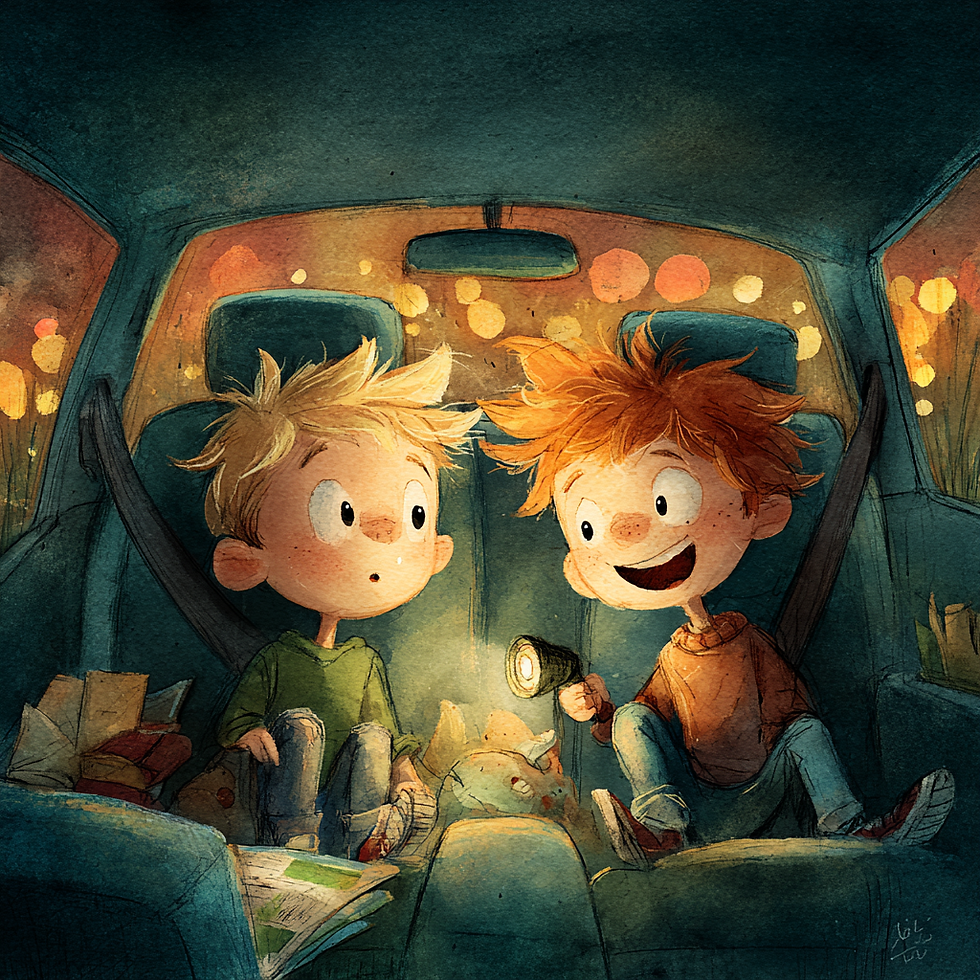
I walked into Silas's bedroom one afternoon expecting to find what I had seen for years—two boys occupying the same room while each disappeared into his own world. Instead, I found them building an imaginary world with toy cars, talking, laughing, negotiating, making up rules as they went. No therapist had orchestrated it. No adult had stepped in to facilitate it. They had simply found one another.
For years they had played beside each other. Now they were playing together.
Sometimes, the milestones that change you most aren't the ones you've been watching for. Pete and I still wrestle with one question more than almost any other: How do we teach Silas to love his brother without ever making him feel responsible for him?
I don't know the answer yet.
Some days, I wonder if we've accidentally asked too much of him simply because he's so willing to give it. Other days, I realize that the qualities I admire most in him—his awareness, his kindness, his instinct to protect—are the very things I never want him to lose.
We're still learning where that line belongs.
When I picture my boys years from now, I don't imagine perfect harmony. I imagine brothers. I imagine fishing trips, arguments over nothing, borrowed tools, inside jokes no one else understands, and stories that grow a little bigger every time they're told. I hope Silas always looks out for Khai, and I hope Khai always knows his brother is someone he can count on.
But I also hope they each have the freedom to become fully themselves. Brothers walk beside one another. They were never meant to carry each other.


Comments